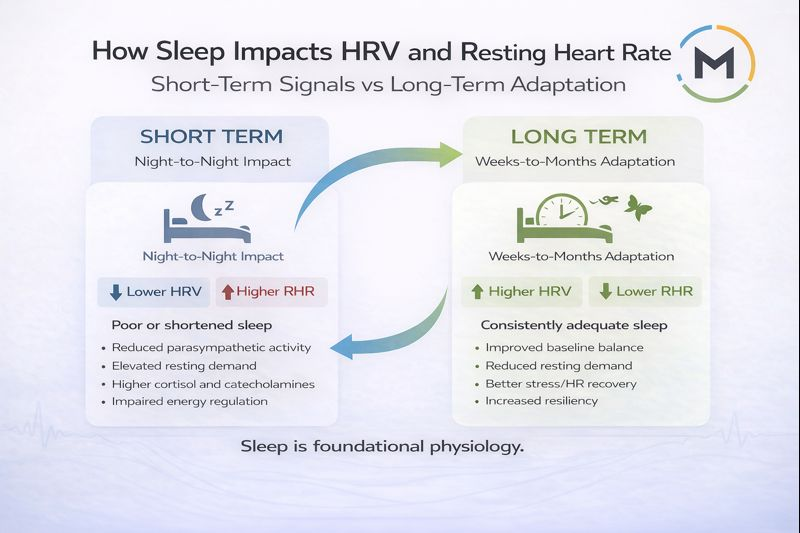
Short-Term Signals vs Long-Term Adaptation
Sleep is one of the strongest drivers of both HRV and resting heart rate — but not always in the way people expect.
Sleep doesn’t just “make numbers better.”
It shapes how the autonomic nervous system functions across days, weeks, and months.
Understanding the difference between short-term responses and long-term trends is critical.
The Short-Term Impact (Night-to-Night)
Poor or shortened sleep
Common physiological response:
• HRV decreases
• Resting HR increases
Why:
• Increased sympathetic activity
• Reduced parasympathetic recovery
• Elevated cortisol and catecholamines
• Higher metabolic demand at rest
This is the body staying on the gas pedal longer than it should.
Occasionally “good” sleep
You may see:
• HRV increase
• RHR decrease
But not always.
Why?
Because the nervous system doesn’t reset instantly.
One good night does not erase accumulated load.
Why HRV can be high after poor sleep
This confuses people.
Sometimes HRV increases after:
• Fragmented sleep
• Short sleep
• Illness onset
This often reflects:
• A compensatory parasympathetic response
• The body trying to recover — not having recovered
Higher HRV ≠ better recovery on a single day.
The Long-Term Impact (Weeks to Months)
Consistently adequate sleep
Over time leads to:
• Higher baseline HRV
• Lower baseline resting HR
• Faster recovery from stress
• Improved stress tolerance
• More stable training responses
This is true adaptation.
Chronic sleep restriction (even mild)
Often results in:
• Suppressed HRV baseline
• Elevated resting HR
• Reduced resilience to training stress
• Slower recovery
• Increased illness and injury risk
The key word is chronic.
Sleeping 5–6 hours “most nights” is not neutral.
It is a persistent stressor.
Sleep Debt Is Cumulative
The nervous system tracks:
• Total sleep time
• Sleep consistency
• Circadian alignment
• Fragmentation
You don’t “catch up” in one night.
Recovery from sleep debt occurs gradually — just like adaptation.
Why This Matters for Training Decisions
When sleep is compromised:
• HR rises faster during workouts
• HR drifts sooner
• VO₂ and threshold sessions cost more
• Recovery metrics become less predictable
If sleep is poor, training stress counts more.
Ignoring sleep while interpreting HRV and RHR leads to bad decisions.
The Big Takeaway
Sleep affects:
• Daily readiness
• Recovery capacity
• Long-term autonomic balance
Short-term changes tell you what the system is dealing with now.
Long-term trends tell you what the system has adapted to.
HRV and RHR don’t respond to intention.
They respond to what you repeatedly do.
Sleep is not optional recovery.
It’s foundational physiology.