
One of the most common misconceptions in the HRV world is this:
HRV up = always good
HRV down = always bad
High HRV = high recovery score
Unfortunately, many devices and apps reinforce this idea.
But it’s not true.
And it’s definitely not that simple.
At Morpheus, we take a much deeper approach—because understanding context is everything when it comes to HRV and recovery.
Average HRV vs. Daily HRV (This Matters)
Generally speaking, higher average HRV over long periods of time is a good thing. It usually reflects improved resilience and fitness.
But that is very different from a single day where HRV is much higher (or lower) than your recent average.
Morpheus compares:
Today’s HRV and RHR
Against your recent baseline (rolling average)
When your HRV is meaningfully above or below that rolling average, your recovery score will be lower for that day.
This is why:
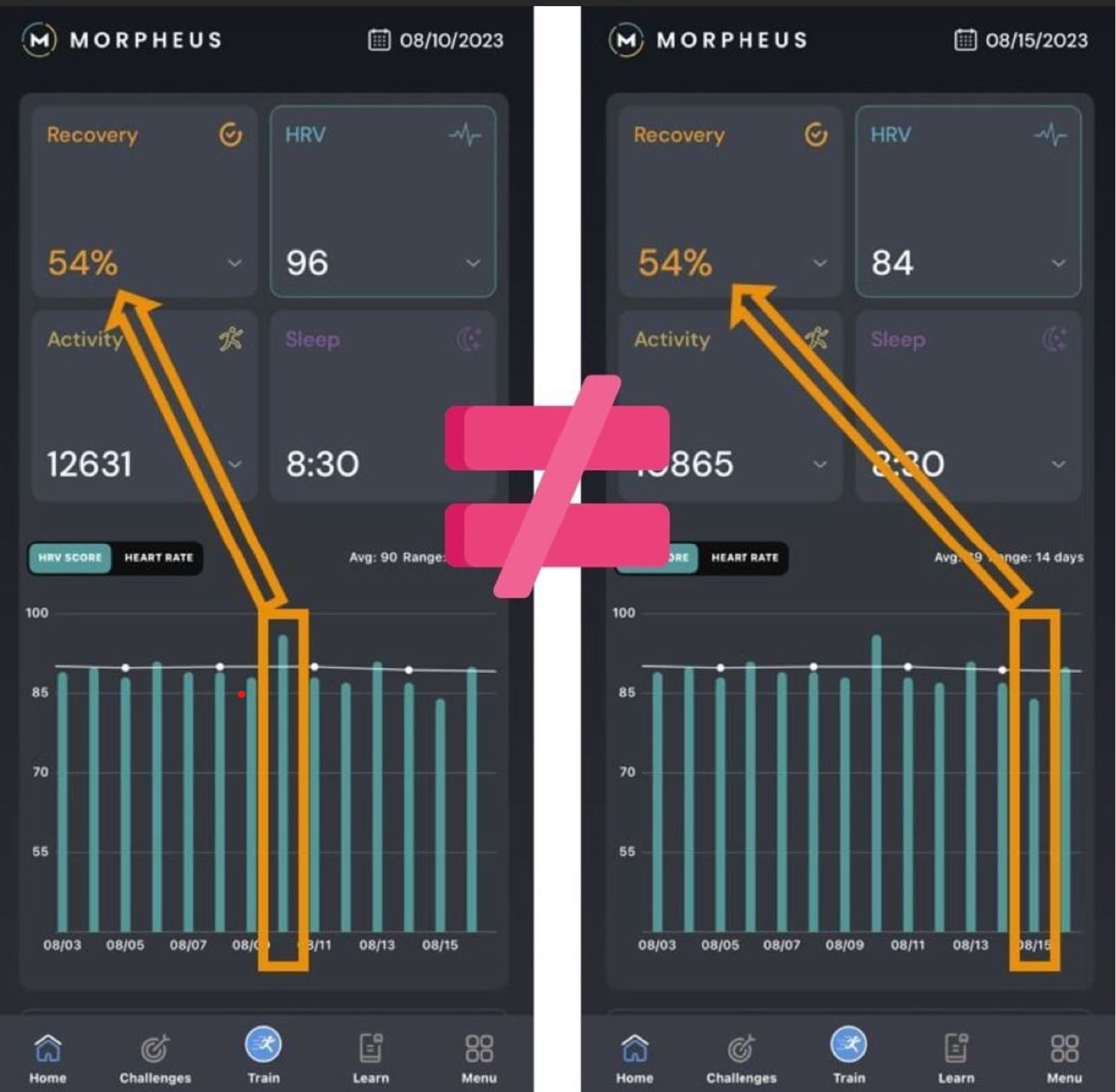
You can have low HRV + low recovery
Or high HRV + low recovery
And those two situations mean very different things.
Same Recovery Score. Very Different Message.
When recovery is low, it’s critical to understand why.
A low recovery score paired with:
LOWER-than-average HRV
Indicates sympathetic dominance
Your system is spending more energy in a stressed, activated state
Regeneration should focus on relaxation
HIGHER-than-average HRV
Indicates parasympathetic dominance
Your body is pouring energy into recovery processes
Regeneration should focus on gentle stimulation
This distinction matters for both training and lifestyle choices that day.
What To Do When Recovery Drops Below ~60%
When your morning recovery score comes in below ~60%, it’s often a good idea to include regeneration work that day.
This doesn’t automatically mean “do nothing.”
In fact, targeted regeneration can help you recover faster and more completely than simply skipping all movement.
The key is matching the type of regeneration to the state of your nervous system.
HRV Responds to All Stress — Not Just Training
One reason HRV can feel confusing is because it reflects your response to total stress.
Workouts are only one piece of the puzzle.
Mental stress, poor sleep, emotional stress, illness, travel, dehydration, and nutrition all contribute—and often impact recovery more than the workout itself.
To your nervous system:
Stress is stress.
And recovery ultimately sets the ceiling for how much adaptation you can get from training.
How HRV Normally Behaves Around Training
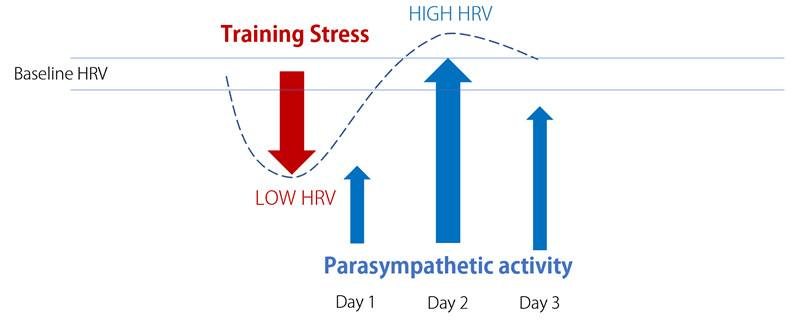
A normal training stress curve looks something like this:
Training stress → HRV drops
Recovery begins → HRV rises
HRV returns toward baseline → recovery score improves
The only time recovery scores are truly high is when HRV stays within normal limits—close to your recent baseline.
Any time HRV drifts far enough above or below that baseline, recovery score goes down.
When High HRV ≠ “Recovered”
If HRV rises above your average and recovery score drops, that often means:
Your body is actively recovering.
It is recoverING, not yet recoverED.
This is common after:
A rest day
A deload
A large accumulated stress period
Your body is allocating a lot of energy toward parasympathetic recovery processes.
This is not a green light for max effort—it’s a signal to support recovery.
When High HRV Can Actually Be a Red Flag
Just like low HRV isn’t always bad, high HRV isn’t always good.
Here are a few examples where elevated HRV does not reflect improved health or performance:
Mild illness
Immune activation can raise HRV
Helpful for fighting illness, but not a sign of increased fitness
Hyper-recovery
When stress overwhelms the system and resources are depleted
The body may force itself into an exaggerated recovery state
This is protective—but not ideal for long-term performance
Chronic low-grade stress
Constant recovery attempts can keep HRV elevated short-term
If HRV is high but you feel persistently drained, something is off
Over time, unresolved stress will eventually drive HRV down
A Very Important Reminder
A single day change in HRV (up or down) is NOT predictive of performance.
People often:
Feel fine but see a low recovery score
Train anyway and still perform well—or even hit PRs
This is why recovery scores should never be interpreted as capability limits.
So What Is a Recovery Score, Really?
To understand recovery, we need to talk about two things:
Stress and energy.
Training works because the body adapts:
Lift heavy → get stronger
Run consistently → get more efficient
Practice skills → improve technique
This adaptation requires:
Stress (training)
Energy to recover from that stress
Recovery is simply the process of using energy to repair, rebuild, and adapt.
The Right Way to Use Morpheus Recovery Scores
A low recovery score does not mean:
You can’t train
You must take the day off
You’re fragile or broken
A higher recovery score does not automatically mean:
Go all-out
Ignore fatigue signals
Chase intensity at all costs
Instead, Morpheus recovery reflects the balance between energy spent on stress vs. energy spent on recovery.
Final Takeaway
A recovery score gives insight into what you should consider doing.
It does not dictate what you can or cannot do.
Life is a series of decisions—hundreds of them every day.
Use Morpheus as a decision-making tool to:
Train smarter
Recover better
And improve health and performance over the long term

Below are more specifics about different types of relaxation and stimulation methods.
