
Heart Rate Variability (HRV) has become a widely used metric in fitness apps — and it’s at the core of how Morpheus calculates your Recovery Score.
But what exactly is HRV?
The simple explanation:
When measured daily, HRV is a noninvasive way to see how much energy your body is putting toward recovery.
Because of that, HRV gives us a window into the physiological cost of all the stress your body has been under recently.
Over the long term, your baseline HRV is a powerful marker of your body’s resilience to stress — both physical and mental.
People with higher average HRV tend to have:
• Greater life expectancy
• Lower disease risk
• Higher cardiovascular fitness
• Better emotional regulation and self-control
To understand why, we need to look at how HRV is directly connected to recovery.
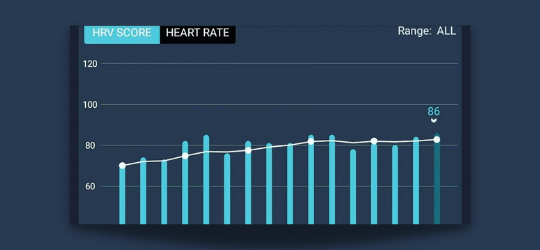
Your Heart Is Not a Metronome
Heart rate and heart rate variability are often confused — but they are very different.
Most people’s heart beats:
• 60–100 times per minute at rest
• Lower than that if they’re aerobically fit
Resting heart rate is useful for gauging fitness, but it doesn’t tell us much about daily recovery status.
HRV looks deeper.
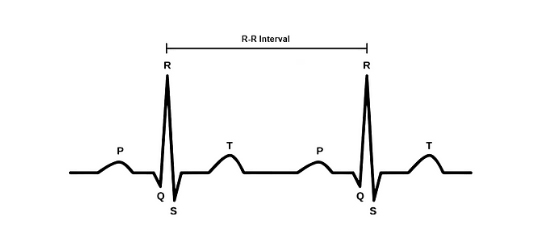
Instead of counting beats per minute, HRV measures the exact time between each heartbeat — called the R-R interval.
If your heart worked like a metronome, every beat would be evenly spaced.
But the human body is far more complex.
What Controls Heart Rate Variability?
Your heart rate constantly changes based on what your body needs.
During activity or stress:
Your sympathetic nervous system (fight-or-flight) increases heart rate to deliver more oxygen for energy.
At rest:
Your parasympathetic nervous system (rest-and-recover) takes over.
This system slows the heart rate and drives energy toward:
• Recovery
• Repair
• Adaptation
But it doesn’t slow the heart in a steady rhythm — it fires in pulses, creating natural variation in the time between beats.
The stronger this recovery system is working, the more variable the R-R intervals become.
Higher HRV = more parasympathetic activity = more energy directed toward recovery
How HRV Responds to Stress
It’s common to think:
High HRV = Good
Low HRV = Bad
But real life is more dynamic.
Let’s look at what happens after a hard training session.
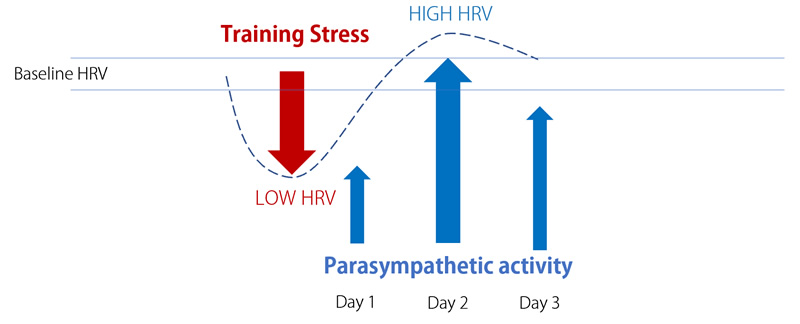
During the stress (hard workout)
HRV drops as the body diverts energy toward handling the immediate demand.
1–2 days after
If recovery is going well, HRV often rises above baseline as the body ramps up repair and adaptation.
How high it rises depends on:
• How hard the workout was
• Your fitness level
• Sleep quality
• Nutrition
• Mental stress
Your lifestyle can either support or sabotage this recovery rise.
Once recovered
If no new major stress is added, HRV settles back to your normal baseline range.
When Life Gets More Complicated
This clean rise-and-fall pattern works best with:
Hard session → Recovery → Adaptation
But many people stack:
Hard day → Hard day → Stress at work → Poor sleep
Now stress piles on faster than recovery can keep up.
This is where HRV trends — not single-day numbers — become critical.
A low HRV on one day isn’t automatically bad.
A downward trend over time can signal accumulating fatigue.
How Morpheus Uses HRV
The good news?
You don’t have to analyze all this yourself.
Morpheus looks at:
• Daily HRV
• Trends over time
• Other recovery markers
to calculate your Recovery Score.
HRV plays the biggest role because, when measured accurately, it is the best overall marker we have of the balance between stress and recovery.
The Big Takeaway
If your goal is to:
✔ Perform at a high level
✔ Look and feel your best
✔ Improve long-term health and resilience
then tracking average HRV trends over time is one of the most powerful tools available.
HRV helps ensure your training, lifestyle, and recovery are working with your body — not against it.