Resting heart rate (RHR) and heart rate variability (HRV) are often discussed separately.
But the real insight comes from how they move together.
They’re both reflections of the same underlying system — the autonomic nervous system — just from different angles.
RHR as a measure of how hard the system is working at rest
HRV as a measure of how much flexibility or capacity the system has
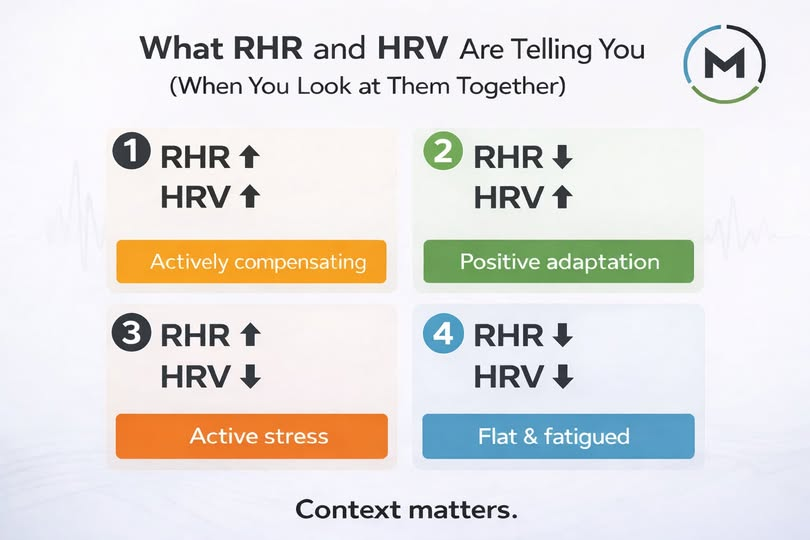
Here’s how to interpret the four most common combinations.
 RHR ↑ and HRV ↑
This one confuses a lot of people.
At first glance, higher HRV looks “good.”
But when RHR is also elevated, it usually means the system is actively compensating.
What’s happening:
Sympathetic stress has increased (illness, travel, cumulative fatigue, heat, inflammation)
The parasympathetic system is pushing harder to regain control
HRV rises as part of that compensatory response
This is often seen:
After a block of heavy training
After poor sleep combined with high life stress
When training volume suddenly drops but fatigue remains
Key takeaway:
Higher HRV here does not equal readiness.
It often reflects the body trying to recover — not having already recovered.
 RHR ↓ and HRV ↑
This is the most straightforward and generally favorable pattern.
What’s happening:
Cardiovascular strain is low
Autonomic balance is strong
The system is efficient and adaptable
Training load is appropriate
Recovery is matching stress
Sleep and fueling are adequate
Key takeaway:
This usually reflects positive adaptation and readiness.
 RHR ↑ and HRV ↓
This is the clearest red flag.
What’s happening:
Recovery capacity is reduced
Often caused by:
Excessive training intensity or volume
High cognitive or emotional stress
Illness, dehydration, or caloric mismatch
Key takeaway:
The body is strained and struggling to keep up.
This is typically a signal to pull back, not push.
 RHR ↓ and HRV ↓
This one is subtle and often misunderstood.
Lower RHR looks good.
Lower HRV looks bad.
So which is it?
What’s happening:
Overall demand may be lower
But nervous system responsiveness is reduced
This can occur:
During under-recovery masked by reduced activity
When training intensity drops but the system hasn’t fully rebounded
In periods of low stimulation or monotony
Key takeaway:
This often reflects a system that is flat & fatigued, not fresh.
The Bigger Point
No single metric tells the full story.
RHR and HRV are signals — not scores to chase.
They need context, trends, and pairing to mean anything useful.
This is why interpreting physiology requires more than:
Or “RHR is low, so I’m fine”
Your body doesn’t operate in silos.
And neither should your interpretation.
We will eventually be adding an AI model into Morpheus to assist with this type of interpretation.