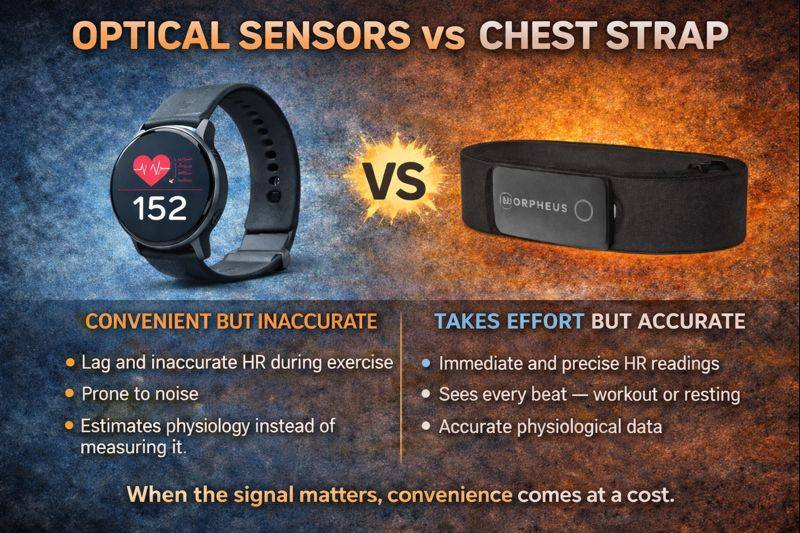
If you’re tracking things like HRV, resting HR, recovery, HR and HR Zone during workouts — accuracy matters.
Not because any single number is magical — but because every insight you take away depends on the quality of the heart rate data.
Chest straps and optical sensors are not measuring heart rate in the same way.
Convenience vs Accuracy (The Tradeoff)
We live in a world optimized for convenience.
Faster. Easier. Less friction.
And most of the time, that’s a good thing.
But convenience often comes with tradeoffs.
Optical heart rate sensors are convenient:
• Always on
• No extra equipment
• No setup
• No thought required
A chest strap requires:
• Putting it on intentionally
• Proper placement
• Moistening electrodes
• Remembering to wear it
That small amount of friction is exactly why many people avoid it. And I spend many hours every week explaining to Morpheus users how to use a chest strap HRM correctly.
But that friction exists for a reason:
it produces a cleaner signal.
What a Chest Strap Measures
A chest strap detects the electrical signal that causes your heart to contract.
It measures the heartbeat itself.
That means:
• True beat-to-beat timing
• Millisecond-level precision
• Immediate detection of intensity changes
• Consistent accuracy at rest and during movement
This is why chest straps are the reference standard for:
• HRV
• Resting heart rate
• Recovery metrics
• Workout heart rate and HR zone tracking
What Optical Sensors Measure
Optical sensors (wrist, arm, ring, etc) do not detect heartbeats.
They estimate heart rate by shining light into the skin and measuring changes in blood volume.
At rest, in ideal conditions, this can be “close enough” to chest strap accuracy.
During workouts — especially intervals, fast movements, direction changes, body position changes, etc — accuracy drops sharply.
Why optical sensors struggle during dynamic activity:
• Blood flow lags behind heart rate
Heart rate changes instantly. Peripheral blood flow does not.
• Movement artifacts
Arm swing, grip changes, impact, vibration, tattoos, skin lotions, skin tone, and muscle contractions all distort the signal. Just sit resting in a chair and breathing normally, make a fist and bang your hand on your leg repeatedly for a minute. You may see your heart rate via an optical sensor increase to 150 or more when your actual HR may be 60.
• Signal smoothing and averaging
To reduce noise, optical sensors often smooth data — which delays spikes and blunts peaks.
• Temperature and blood flow changes
Heat, cold, and stress affect skin perfusion.
• Sensor position variability
Small placement changes and shifting of the device while wearing it create large errors.
These issues compound during:
• Strength training
• Anything that requires grip (rowing, kettlebells, etc)
• Stop-and-go efforts (ie. intervals)
The result:
• Lagged HR response
• Missed peaks
• Underestimated or overestimated intensity
• Incorrect HR and incorrect time spent in HR Zones
Why This Matters for Training and Recovery
When workout heart rate is inaccurate:
• Intervals can look easier or harder than they were
• Training load is underestimated or overestimated
• Stress accumulation is misrepresented
When resting metrics are inaccurate:
• HRV trends lose clarity
• RHR becomes harder to interpret
• Recovery guidance becomes less reliable
The system then can’t accurately distinguish:
• Productive stress vs excess stress
• Adaptation vs compensation
• Recovery vs fatigue
At that point, you’re not really measuring physiology.
You’re measuring convenience.
The Bigger Question
If you’re going to track:
• Workouts
• HRV/RHR
• Recovery status
It’s worth asking:
Why track these things at all if accuracy isn’t a priority?
Physiology changes in subtle ways.
Adaptation happens quietly.
Recovery doesn’t announce itself.
Those shifts only show up when the signal is clean.
Bottom Line
Choosing a chest strap isn’t about being extreme or anti-tech or old-school.
It’s about:
• Capturing what actually happened
• Avoiding delayed or smoothed-over data
• Making better training and recovery decisions
Because whether you’re training or recovering…
Accuracy matters more than convenience.