Zone 2 training is often taught as:
“Just stay in the heart rate zone.”
See HR creep up → slow down
See HR rise again → slow down more
Repeat until you’re barely moving
That approach misses the point.
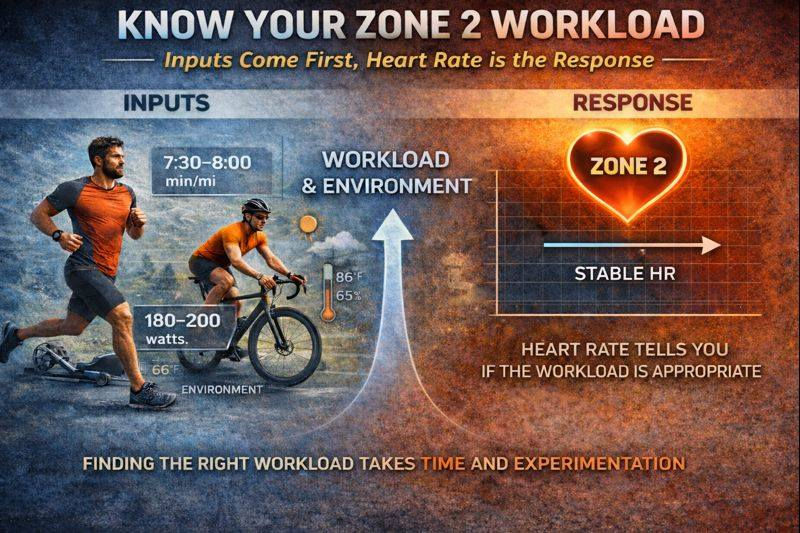
Heart rate is not the input.
Workload and environment are the inputs.
Heart rate is the response.
Your heart rate is giving you feedback about whether the workload you chose is appropriate for:
• Your current fitness
• Your recovery state
• The environment (heat, humidity, altitude, etc)
• Fatigue accumulated during the session
This is why it’s so important to know your Zone 2 workload range:
• Running pace or speed
• Cycling watts
• Rowing power
• Any output you can hold steadily
This is the workload you can maintain for an extended period while heart rate stays stable — with minimal upward drift.
Why HR Drift Matters
Some heart rate drift is normal.
But excessive drift tells you something important:
The workload is too high for your current aerobic capacity under those conditions.
If you respond by continuously slowing down just to keep HR in Zone 2, you’re no longer training a consistent stimulus — you’re reacting to symptoms instead of addressing the cause.
Instead, the goal is:
• Choose a workload
• Observe the heart rate response
• Adjust next time, not every minute
Why Workload Comes First
When workload is appropriate:
• HR rises gradually
• HR stabilizes
• Drift is small and predictable
When workload is too high:
• HR keeps climbing
• Breathing changes
• Perceived effort rises
• Drift accelerates
Heart rate is acting as a proxy for internal strain, not a control knob you twist in real time.
This is why experienced endurance athletes anchor Zone 2 sessions to:
• A known pace
• A known wattage
• A known output range
And then check heart rate to confirm it still fits.
This Takes Time (and That’s Normal)
Finding your true Zone 2 workload is not a one-session process.
It takes:
• Repeated sessions
• Different environments
• Different recovery states
• Honest observation
Early on, you’ll likely overshoot.
That’s part of learning.
Over time, patterns emerge:
• “This pace works when I’m fresh.”
• “This wattage drifts too much in heat.”
• “This output is sustainable for 60+ minutes.”
That’s aerobic development in action.
This is also one way to know that you are improving your cardio fitness...when the workload range you've been using for Zone 2 training no longer gets your heart rate as high as it used to and/or the upward drift is almost non-existent.
This means you can start to inch up your workload in future sessions. Then rinse and repeat.
The Big Takeaway
Zone 2 training is not about forcing heart rate into a static box.
It’s about:
• Selecting the right workload
• Letting heart rate respond
• Using that feedback to refine future sessions
Workload is the stimulus.
Heart rate is the messenger.