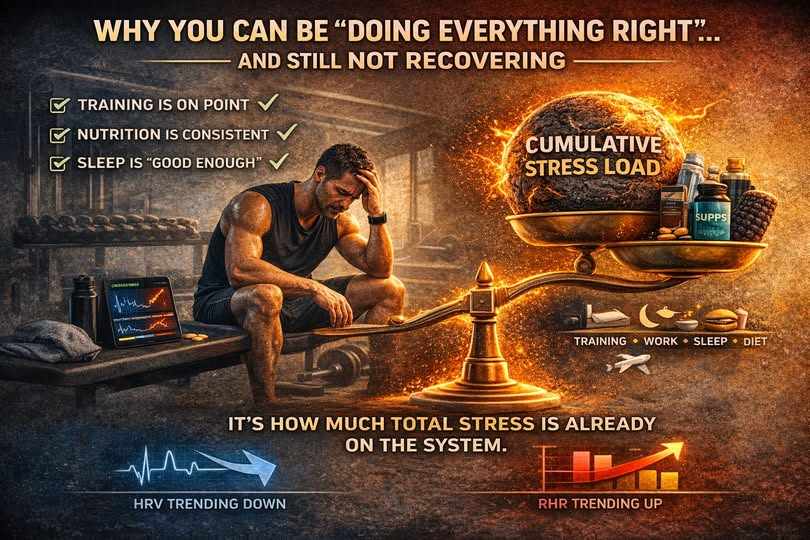
This is one of the most frustrating experiences for people who care about their health and performance.
Training is on point.
Nutrition is consistent.
Sleep is “good enough.”
Yet:
HRV is trending down
Resting heart rate is creeping up
Recovery scores aren’t rebounding
The natural response is to look for something missing.
More mobility
More supplements
More breathwork
More recovery tools
But very often, the issue isn’t what you’re not doing.
It’s how much total stress is already on the system.
The nervous system doesn’t recover from one stressor at a time.
It responds to the sum of everything placed on it.
That includes:
• Training volume and intensity
• Cognitive and emotional load
• Sleep debt (even mild, repeated short nights)
• Caloric mismatch
• Inflammation
• Travel or schedule disruption
Each one may seem manageable on its own.
Together, they compound.
This is why recovery doesn’t always improve by adding things.
At a certain point, the system doesn’t need more stimulation — even “recovery” stimulation.
It needs:
• Reduced load
• Better timing
• Better matching of recovery type to nervous system state
Sometimes the most effective recovery choice is:
• Pulling intensity and/or volume back
• Replacing a hard session with low-level movement
• Allowing the system to stabilize before pushing again
This is where objective data becomes valuable.
Because conscious perception alone often lags behind physiology.
By the time you feel run down, the nervous system has usually been compensating for a while.
Recovery is not about doing everything.
It’s about doing what the system can actually absorb right now.