
The idea that roughly 80% of training should be lower to moderate intensity and ~20% higher intensity is often referred to as the “80/20 rule.”
It’s not a magic formula.
And it’s not new.
It emerged from decades of observation in endurance athletes — particularly when researchers started looking at what successful athletes were actually doing, not what they said they were doing.
Across sports, levels, and distances, a consistent pattern showed up:
Most high performers spent the majority of their time at relatively easy intensities… and a smaller amount of time at very high intensity.
Why this distribution makes sense physiologically
Low-to-moderate intensity work:
Builds aerobic capacity
Improves mitochondrial density
Enhances fat oxidation
Strengthens the cardiovascular system
Supports nervous system stability
Is recoverable enough to repeat frequently
High-intensity work:
Improves VO₂ max
Raises lactate tolerance
Increases neuromuscular power
Creates a strong adaptation signal
The key difference?
Cost.
High-intensity training delivers a big stimulus — but at a high physiological price:
Greater autonomic stress
Longer recovery time
Higher injury risk if overused
The 80/20 approach balances stimulus vs. recoverability.
Why people get it wrong
Many people think they’re training 80/20.
In reality, they’re often doing something closer to:
40% easy
60% moderate-to-hard
That middle zone — “comfortably hard” — feels productive but tends to:
Accumulate fatigue
Suppress HRV over time
Push recovery costs higher without adding much upside
The result is stagnation, not progress.
What “80% easy” actually means
Low-to-moderate intensity should feel:
Sustainable
Conversational
Controlled
Stable from a heart rate standpoint
This is where knowing your workload for Zone 2 matters.
If heart rate drifts significantly at a given pace or power, the workload is too high for extended aerobic work — even if it feels easy at first.
What the 20% is for
The higher-intensity 20% should be:
Purposeful
Structured
Separated from easy days
Fully supported by recovery
This includes:
Intervals
Threshold work
VO₂ max sessions
Short, intense efforts
These sessions are not meant to be frequent.
They’re meant to be effective.
How to apply 80/20 in real life
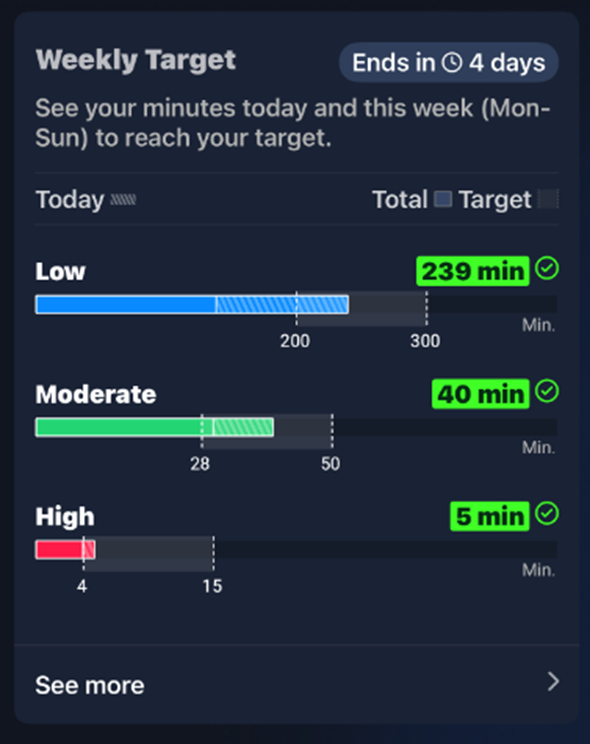
Think in weekly totals, not individual sessions.
Example:
5 training days
4 days primarily low/moderate intensity
1 day higher intensity
Or:
6–8 total hours of training
~5–6 hours easy/moderate
~1–1.5 hours hard
The exact split doesn’t need to be perfect.
The trend is what matters.
Where HRV and RHR fit in
When the balance is right, you’ll often see:
Stable or improving HRV trends
Controlled resting heart rate
Recovery scores that rebound reliably
When the balance is noticeably off:
HRV trends downward
RHR creeps up
“Moderate” days start feeling harder
The body is very honest about this — if you’re paying attention.
The takeaway
The 80/20 approach isn’t about training less hard.
It’s about training hard when it matters and easy when it doesn’t.
Consistency comes from recoverability.
Progress comes from the right stress.
And the combination of the two is what actually moves fitness forward.