
Progress doesn’t come from stacking hard days on top of hard days.
It comes from creating a rhythm of stress and recovery.
Alternating challenging sessions with easier ones allows the body to adapt, the nervous system to reset, and recovery metrics like HRV to rebound in a productive pattern.
Training works best when it follows an oscillation, not a constant grind.
Stress–Recovery Oscillation
Every hard workout creates stress.
That stress is necessary — it signals the body to adapt.
But adaptation only happens when stress is followed by enough recovery for the system to rebuild stronger.
Hard days push the system down.
Easy days allow it to rebound.
When this wave pattern is repeated consistently, fitness trends upward over time.
Without the recovery phase, stress just accumulates.
A single period of loading and recovery is called a stress-recovery cycle.
Each week, your goal should be to use 1-2 of these cycles to push your body to increase its fitness, and then give it the time to do exactly that through recovery.
This is how you balance both sides of the equation and create a sustainable way to make consistent progress towards your goals.
Two of the easiest and most effective ways you can build your training week around this concept is the 1/2/3 and 2/2/2.
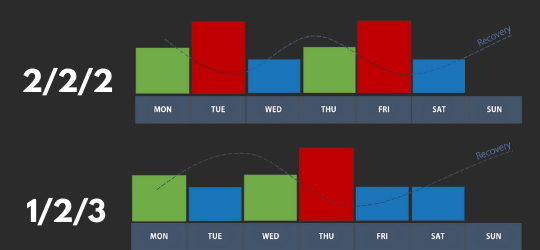
Both have up to 6 total days of training per week, but they vary in how they’re organized and the patterns of the stress-recovery cycle.
The 1/2/3 weekly model
The 1/2/3 weekly model is a great option for people that are just training to look and feel their best, while staying healthy.
A single red day on Thursday, followed by either blue days, or even days off, over the weekend, makes it extremely flexible for people with busy schedules and stressful daily lives.
The 2/2/2 weekly model
For people with higher levels of fitness that generally have things like nutrition, sleep, and lifestyle stress managed well, the 2/2/2 weekly model is a highly effective approach.
It allows for two red days spread throughout the week, while still allowing enough time for full recovery before the start of each week.
Why Easy Days Matter for the Nervous System
Hard sessions often require strong sympathetic activation.
That’s useful for performance, but staying in that state too long slows recovery.
Easy days — low-intensity aerobic work, technique work, mobility, or lighter strength sessions — help the nervous system shift back toward parasympathetic dominance.
This:
Reduces accumulated stress
Improves circulation
Supports hormonal balance
Allows HRV to recover
These easier sessions aren’t “missed opportunities.”
They’re what make the hard days effective.
HRV Rebound Patterns
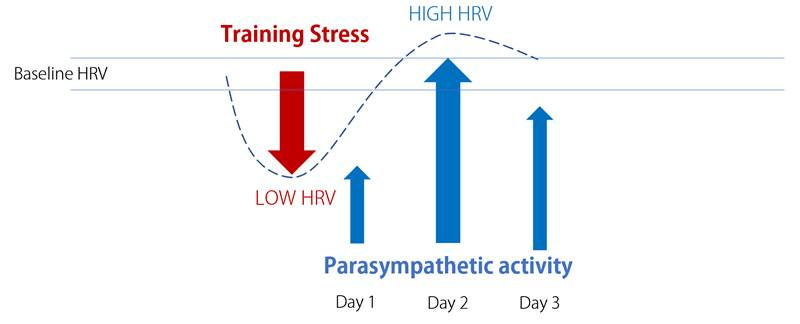
When training is structured well, HRV often shows a pattern like this:
Dip after hard session
Rebound after easy day
Stabilize or trend upward over time
That rebound is a sign the system is absorbing the stress.
If hard days stack without recovery, HRV may:
Stay suppressed
Trend downward
Become unstable
That’s a sign recovery isn’t keeping up with stress.
Why Constant Moderate Training Doesn’t Work as Well
Training at a medium-hard level every day feels productive.
But it often keeps the body in a gray zone:
Too hard to fully recover
Not hard enough to drive strong adaptation
Alternating clear hard days with true easy days creates stronger signals and clearer recovery windows.
The body responds better to contrast than to constant pressure.
The Big Takeaway
Hard training builds stress.
Easy training allows adaptation.
Alternating between the two creates a rhythm that supports long-term progress, nervous system balance, and healthy HRV trends.
Easy days aren’t a step backward.
They’re what allow the hard work to actually make you fitter.