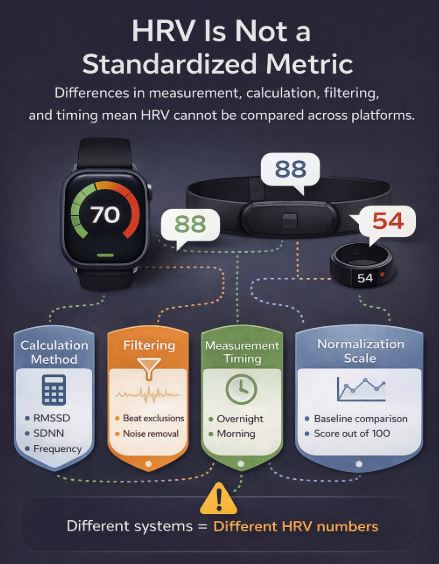
People often treat HRV like heart rate or steps — a universal number that should match across devices.
It’s not.
Heart rate is straightforward: beats per minute. Speed is distance over time. Power is force output.
HRV is different. It is not one single measurement. It’s a collection of statistical methods applied to tiny timing differences between heartbeats — and there is no global standard for how that should be done.
That’s why HRV from one platform often cannot be directly compared to HRV from another.
HRV Isn’t One Number — It’s a Category of Calculations
HRV describes variation in the time between heartbeats, but there are multiple ways to calculate and summarize that variation.
Some of the most common include:
• RMSSD – emphasizes short-term parasympathetic activity
• SDNN – reflects overall variability across a longer window
• pNN50 – looks at how often large beat-to-beat changes occur
Each one is mathematically different. They can move in different directions on the same day.
So before you even look at a value, you have to ask:
Which HRV metric is being used?
Morpheus uses RMSSD because it is well suited to short, controlled measurements and reflects changes in autonomic balance in a meaningful way for training and recovery decisions.
But even when two platforms both use RMSSD, the story still isn’t over.
Raw HRV in Milliseconds Is Noisy and Hard to Interpret
RMSSD is measured in milliseconds — but raw HRV values are extremely sensitive.
Breathing pattern, posture, hydration, recent stress, and even minor movement can shift values. That makes raw data very “jumpy” and difficult for most people to use.
This is why many platforms apply normalization or scoring systems.
These systems:
• Compare you against your own baseline
• Reduce day-to-day noise
• Make trends easier to interpret
The number you see in an app is not just HRV — it’s HRV that has been filtered, smoothed, and translated into a user-friendly format.
Different platforms use different math for this. So two apps can start with the same heartbeat data and display completely different “HRV scores.”
Data Filtering Changes the Result — A Lot
HRV calculations depend on detecting very precise timing between beats. But real-world data is messy.
Sensors pick up:
• Movement artifacts
• Missed beats
• Extra beats
• Electrical noise
Every platform must decide:
• Which beats to throw out
• How to smooth irregular intervals
• How long a clean segment must be
There is no universal rulebook. Different filtering rules can change HRV values significantly.
So when two devices disagree, it’s often not that one is “wrong.” They simply cleaned the data differently before doing the math.
Measurement Timing Changes What HRV Represents
HRV isn’t just about math — it’s also about when you measure it.
Overnight HRV:
• Captures the nervous system during sleep
• Reflects how well the body shifted into parasympathetic dominance
• May smooth out stress signals because sleep suppresses daytime activation
Morning HRV (measured when awake):
• Captures your nervous system in a conscious state
• Reflects mental stress, anticipation, and life load
• Often detects strain that didn’t show strongly overnight
So an overnight reading and a morning reading are not measuring the same physiological context. They answer different questions.
This is one reason overnight numbers can look “fine” even when you wake up feeling strained — and why morning spot checks often align better with how the day feels.
Sensor Type Also Matters
Chest straps measure the heart’s electrical signal directly. Optical sensors estimate pulse waves from blood flow.
Small timing errors in beat detection dramatically affect HRV calculations. Optical systems are more prone to slight delays and smoothing, which can reduce the accuracy of variability measurements.
So even before math and filtering, the input signal can differ between devices.
HRV Is Relative, Not Absolute
Because of differences in:
• Calculation method
• Filtering algorithms
• Normalization scales
• Timing of measurement
• Sensor technology
HRV from Platform A cannot be directly compared to Platform B.
The value of HRV lies in how it changes relative to your own baseline within the same system — not in the raw number itself.
The Big Takeaway
HRV is an extremely valuable metric but is not a standardized metric like heart rate or pace. It’s a set of statistical calculations layered on top of filtered heartbeat data, measured under different conditions and displayed on different scales.
That’s why numbers vary across devices — and why comparisons between platforms are misleading.
HRV works best as a trend tool within a single system, showing how your nervous system is changing over time, not how your number compares to someone else’s or another app’s.