
One of the most common questions in training is:
“How much training should I do each week… and how hard should it be?”
For decades, coaches and athletes have debated the ideal balance between volume (how much) and intensity (how hard). Some advocate high-volume low-intensity work, others argue for high intensity and less volume, and many fall somewhere in between.
The reality — backed by large data sets and real-world results — is that there’s no one-size-fits-all answer. What does produce consistent improvements is the right combination of volume, intensity, and recovery, tailored to your fitness level and recovery capacity.
This is where Morpheus Weekly Zone Targets step in.
Why Volume, Intensity, and Recovery Must Be Balanced
Every training program ultimately boils down to three variables:
Volume – how much training you do
Intensity – how hard that training is
Recovery – how well your body absorbs and adapts to that stress
Getting these right drives adaptation.
Getting even one of them wrong can lead to:
• Stalled progress
• Overreaching or overtraining
• Lack of long-term gains
Volume and intensity together define your training load, but neither should be viewed independently of recovery. How much stress your body can tolerate — and thus how much training makes sense — changes from week to week based on your recovery state, sleep, daily stress, and fitness level.
This is exactly what Morpheus tracks and uses to evolve your weekly targets.
What Morpheus Weekly Zone Targets Are
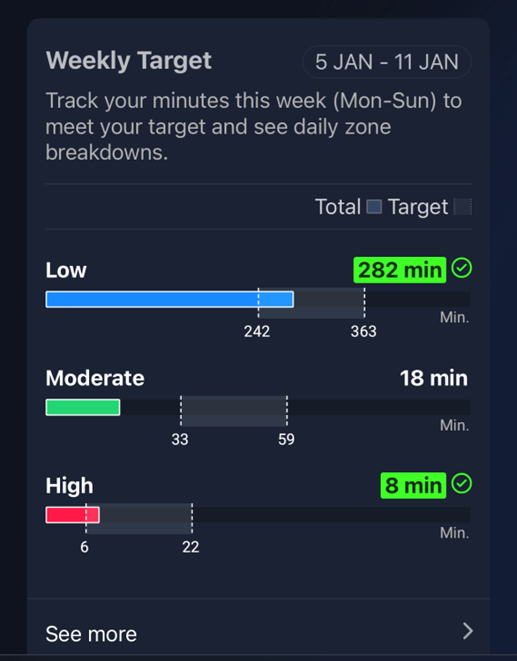
Morpheus breaks training into three heart rate zones — each representing a different intensity category:
• Blue (Recovery) – low intensity
• Green (Conditioning) – moderate intensity
• Red (Overload) – high intensity
Each Monday, Morpheus evaluates:
✔ Your recent training data
✔ Your recovery and HRV trends
✔ Your personal fitness level and goals
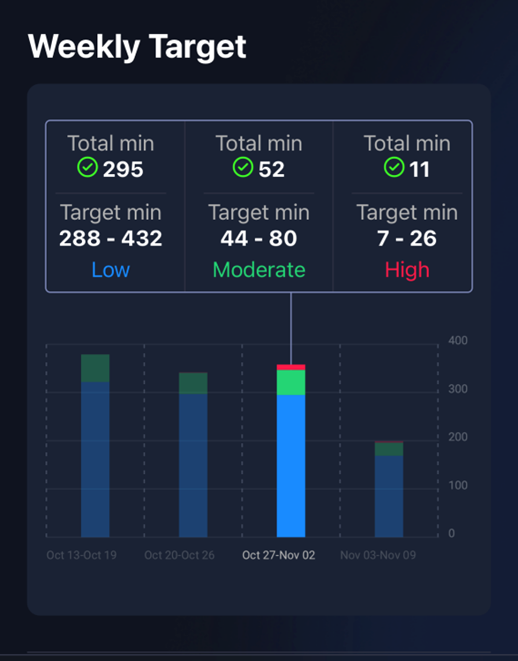
…and then provides a weekly target range for minutes in each zone.
These targets represent the amount of time in each zone that research and Morpheus’s database show is most likely to improve your fitness without overwhelming your recovery.
You can hit any part of the range — top, middle, or bottom — as long as you stay within it. If your metrics trend the wrong direction, Morpheus will adjust your targets down on the next weekly update to prevent excessive load.
What the Data Shows About Volume & Intensity
Thanks to millions of “user-days” of data, Morpheus can observe real training patterns correlated with fitness improvements.
For example:
• People who improved cardiovascular markers over 12 weeks tended to train less overall than those who regressed
• They also spent less time at very high intensities (the Red zone) when their fitness was initially lower, and gradually increased as they got fitter
This reflects a fundamental truth: More is not always better, especially if your fitness baseline isn’t high. Excessive high-intensity training early in a program often leads to recovery debt, suppressed HRV, and slower adaptation, not faster gains.
Why Weekly Targets Are Better Than Arbitrary Minutes
Many training plans tell you to do a certain number of workouts per week, or hit a fixed zone-2 time and repeat-efforts at a certain intensity.
But those static targets:
• Don’t account for individual recovery differences
• Often ignore activity and stress outside your workouts
• Can overemphasize intensity at the wrong times
Morpheus weekly zone targets are different because they:
✔ Are personalized to your current physiology
✔ Adjust based on your recovery trend
✔ Balance volume and intensity for your level
✔ Increase progression only when your body is ready
This adaptive approach ensures training is challenging enough to stimulate improvement without overwhelming your system.
How Weekly Targets Change With Fitness
Targets don’t stay the same forever. As you improve — shown by higher average HRV and lower resting heart rate — Morpheus increases your weekly zone targets to keep driving adaptation. But increases happen only when your body shows it can absorb them.
This prevents stagnation by progressing load intelligently rather than arbitrarily.
Putting It All Together
Here’s the important takeaway:
✔ Volume and intensity both matter
…but their importance changes depending on your fitness and recovery.
✔ Too much intensity too soon slows progress
…because it increases stress faster than your body can adapt.
✔ Weekly training targets give you a roadmap
…so you train enough to improve — but not so much that you fall behind in recovery.
✔ Morpheus uses data, not guesswork
…it learns from millions of workouts to give you targets tailored to your physiology.
When you hit your weekly zone targets consistently — and your recovery stays strong — that’s the foundation of long-term fitness progress.
The Big Takeaway
Training stress must be balanced with recovery stress. Volume and intensity are two sides of that same coin — and neither works in isolation.
Morpheus weekly zone targets use real user data and your own recovery trends to craft weekly volume and intensity targets that evolve with you. This approach helps ensure that every week you’re not just training — you’re progressing.