
Zone 2 has become one of the most talked-about training zones in recent years.
It’s often described as:
• Easy
• Conversational
• Fat-burning
• Aerobic base building
All true.
But one thing people miss is this:
Zone 2 is not the same physiological stress every day.
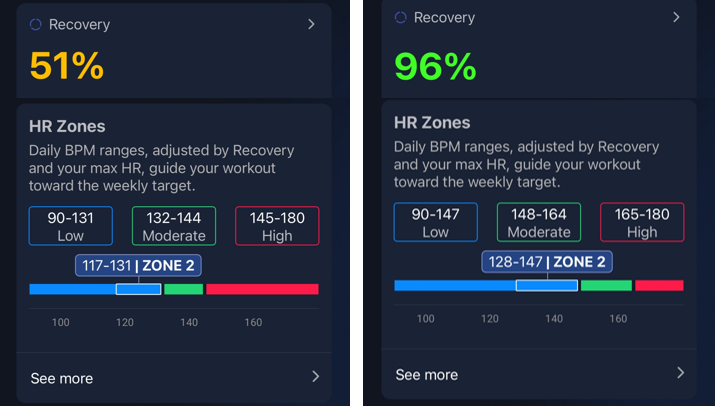
Your body’s ability to handle that workload changes based on recovery, sleep, life stress, and recent training. That’s exactly why Morpheus adjusts zones daily — because the cost of a workout is determined by your state, not just the pace or heart rate.
Why Zone 2 Isn’t the Same Every Day
Zone 2 represents a level of work where your body relies heavily on aerobic metabolism. But your aerobic system is not operating in a vacuum — it’s influenced by:
• Nervous system balance
• Hormonal state
• Inflammation
• Sleep quality
• Prior training load
On a high-recovery day:
Zone 2 feels smooth, controlled, and sustainable. Your heart rate rises slowly, breathing stays steady, and recovery afterward is relatively quick.
On a low-recovery day:
That same Zone 2 heart rate may feel heavier. You may drift upward faster, feel more strain, and need longer to bounce back.
The workload hasn’t changed — your capacity has.
That’s why Morpheus adjusts zones based on recovery score. A lower Zone 2 heart rate on a low-recovery day reflects the fact that the same external workload now costs more internally.
What’s the Minimum Effective Dose of Zone 2?
This varies by person, fitness level, and history — but generally:
For most people, meaningful aerobic stimulus begins around 20–30 minutes of continuous Zone 2 work.
Why?
Because aerobic adaptations depend on:
• Mitochondrial signaling
• Capillary recruitment
• Enzyme activation
• Fat oxidation pathways
These processes take time under steady, aerobic demand to activate.
Short bouts (5–10 minutes) are helpful for movement and circulation, but they typically don’t provide enough sustained stimulus for deeper aerobic adaptations.
More trained individuals may benefit from:
• 40–60+ minutes
Less trained individuals may see benefits from:
• 20–30 minutes
Consistency matters more than occasional long sessions.
When Zone 2 Is Not “Recovery Work”
Zone 2 is often labeled as “easy” or “recovery cardio,” but that’s not always true.
If you are under-recovered — due to poor sleep, illness, travel, or accumulated fatigue — even Zone 2 can become a meaningful stressor.
On these days:
• Heart rate may rise faster
• Cardiac drift may occur earlier
• HRV may remain suppressed afterward
In this state, Zone 2 is still aerobic — but it is no longer low-cost.
That doesn’t mean you should never do it. It means the purpose changes.
Instead of driving adaptation, it may be better used to:
• Promote circulation
• Support gentle aerobic activity
• Maintain routine without adding large stress
Or in some cases, even Zone 2 may need to be shortened or replaced with very low-intensity movement.
Zone 2 as Training vs Zone 2 as Recovery
Zone 2 for adaptation
Used when recovery is good. Duration is long enough to stimulate mitochondrial and aerobic development.
Zone 2 for maintenance
Used when recovery is moderate. Shorter duration, supports circulation and aerobic maintenance without large stress.
Zone 2 that becomes stress
Used when recovery is low. Even moderate aerobic work may delay recovery if duration or intensity is too high.
Morpheus helps distinguish these situations by adjusting zones based on recovery. The goal isn’t to blindly hit a heart rate — it’s to match the stress to your current capacity.
The Big Takeaway
Zone 2 is powerful — but it’s not a fixed experience.
Your recovery state determines whether it acts as:
• A strong aerobic stimulus
• Light supportive movement
• Or an added stressor
Minimum effective doses generally start around 20–30 minutes, but the right duration depends on your fitness and recovery.
Dynamic zones in Morpheus exist for this exact reason:
To make sure the same “Zone 2” heart rate reflects the right physiological stress on that day — not just the same number on a chart.