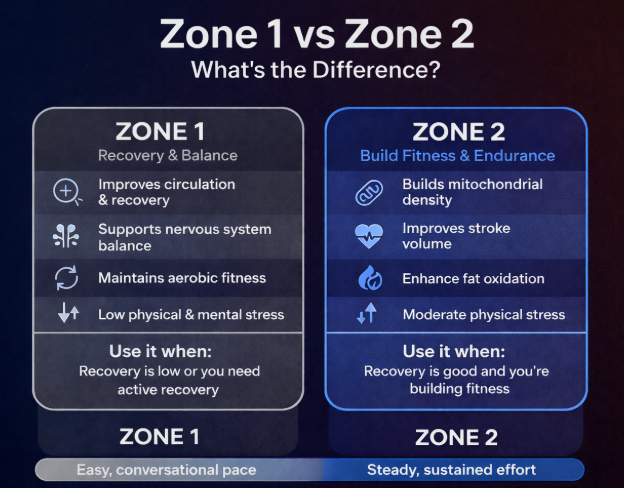
Zone 1 and Zone 2 are often grouped together as “easy cardio.”
They are not the same.
Both are aerobic.
Both are below high-intensity work.
But they serve very different physiological purposes.
Understanding when to choose Zone 1 versus Zone 2 is one of the most important decisions you can make in a recovery-guided training system.
The First Question to Ask
Before you start a session, ask:
Are you trying to recover — or are you trying to build fitness?
That single distinction determines the correct choice.
Zone 1 primarily supports recovery and nervous system balance.
Zone 2 primarily builds aerobic capacity and structural cardiac adaptations.
They overlap in intensity range, but they do not overlap in purpose.
What Zone 1 Is Designed to Do
Zone 1 is low-intensity aerobic work that meaningfully elevates heart rate but remains clearly easy.
It should:
• Raise heart rate above resting levels
• Feel relaxed and sustainable
• Keep breathing controlled
• Avoid muscular strain
For most adults, this means heart rate will often need to stay above roughly 100 beats per minute to create enough circulatory stimulus. If heart rate barely rises, the session is likely too light to produce recovery benefits.
Zone 1 works primarily by improving circulation and autonomic balance.
Physiologically, it:
• Increases blood flow to working and previously trained tissues
• Enhances nutrient delivery
• Supports removal of metabolic byproducts
• Encourages parasympathetic reactivation
It does not significantly challenge the cardiovascular system enough to build stroke volume or mitochondrial density. Instead, it helps restore the system after stress.
Zone 1 is not about adaptation.
It is about restoration.
What Zone 2 Is Designed to Do
Zone 2 requires sustained effort and sufficient duration to create adaptation.
It typically:
• Feels comfortably hard but controlled
• Requires steady breathing
• Produces light sweat
• Demands sustained focus
Zone 2 drives meaningful cardiovascular change by:
• Increasing stroke volume
• Improving cardiac efficiency
• Expanding capillary networks
• Increasing mitochondrial density
• Improving oxygen extraction at the muscular level
These adaptations occur because Zone 2 places sustained demand on the heart and peripheral tissues.
That demand is productive — but it is still stress.
Zone 2 builds the engine.
Zone 1 maintains and protects it.
Why Zone 2 Is Not True Recovery Training
Zone 2 feels manageable, which is why many people mistakenly use it as recovery work.
But physiologically, Zone 2:
• Increases cardiac output significantly
• Elevates metabolic demand
• Activates sympathetic drive to a moderate degree
• Requires meaningful substrate use
If your nervous system is already under strain, adding more Zone 2 may delay recovery rather than accelerate it.
Zone 2 builds fitness best when recovery is already sufficient.
Why Zone 1 Is Not “Junk Volume”
Zone 1 is often dismissed because it does not feel productive.
But its value lies in:
• Supporting HRV rebound
• Improving tissue recovery
• Maintaining movement quality
• Preserving aerobic rhythm between hard sessions
Without Zone 1, athletes often oscillate between hard sessions and total rest. That rhythm is less effective than maintaining light, intentional movement between stress exposures.
Zone 1 increases the consistency of training weeks, which often matters more than the intensity of any single session.
Structural vs Regulatory Adaptations
Zone 2 primarily creates structural changes:
• Heart chamber remodeling
• Increased stroke volume
• Peripheral oxygen extraction
• Improved mitochondrial density
Zone 1 primarily influences regulatory systems:
• Nervous system tone
• Circulatory efficiency
• Recovery kinetics
• Stress modulation
One builds capacity.
The other supports regulation.
Both are essential, but they should not be confused.
When to Choose Zone 1 vs Zone 2
Choose Zone 1 when:
• HRV is mildly suppressed
• Resting heart rate is elevated
• You feel systemic fatigue
• The previous session was high intensity or heavy strength
• Life stress is elevated
Zone 1 allows you to move without deepening the recovery debt.
Choose Zone 2 when:
• Recovery score is strong
• You are building aerobic base
• Weekly aerobic volume is below target
• You are in a fitness-building phase
Zone 2 is most effective when the body is prepared to adapt.
Common Programming Errors
Error 1: Turning recovery days into moderate stress
Moderate effort feels safe, but if recovery is low, even moderate stress accumulates.
Error 2: Doing only Zone 2 and intensity
Skipping Zone 1 often leads to chronic fatigue or inconsistent training.
Error 3: Making Zone 1 too passive
If heart rate does not meaningfully elevate, the circulatory and autonomic benefits diminish.
Intentionality is key.
How Morpheus Helps You Choose the Right Zone
Morpheus recovery scores provide daily context for this decision.
On lower recovery days:
• Zone 1 supports recovery without compounding stress
• It helps HRV rebound and maintains aerobic rhythm
On higher recovery days:
• Zone 2 becomes highly productive
• Stroke volume and mitochondrial adaptations are better supported
Looking at weekly zone distribution also reveals whether your training is too moderate overall. If most time sits in mid-intensity ranges, clearer separation between Zone 1 recovery work and true Zone 2 development may be needed.
Morpheus does not just show intensity. It shows whether your body is ready to benefit from it.
The Big Takeaway
Zone 1 and Zone 2 are both aerobic — but they serve different physiological roles.
Zone 1 supports recovery, nervous system balance, and training consistency.
Zone 2 builds cardiac efficiency, mitochondrial density, and endurance capacity.
Choosing the correct zone on the correct day is what turns aerobic training from random activity into structured progress.
Recovery determines when to build.
Structure determines how.