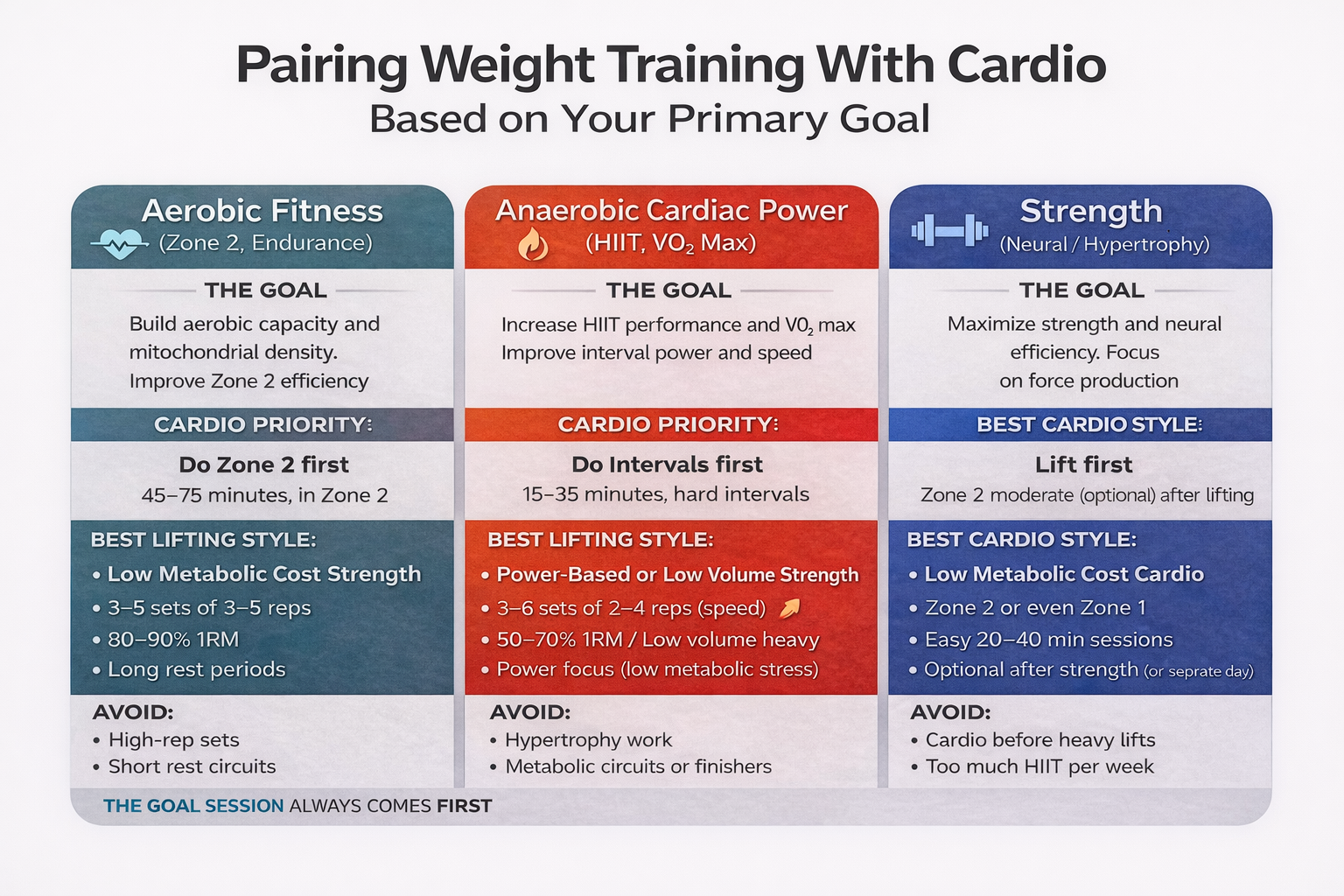
Combining strength and conditioning is powerful.
Done well together, research shows up to a 40% reduction in "all-cause" mortality.
Combining them poorly creates interference and extra stress with no extra fitness gain.
The goal is not to avoid mixing stressors. The goal is to align them so you get the adaptation you want with the lowest unnecessary recovery cost.
To do that, you need:
• A clear primary goal
• Proper pairing of lifting and conditioning
• Smart timing
• Awareness of cumulative stress
First: Why “Competing Signals” Matter
Your body adapts to the dominant signal.
Zone 2 emphasizes:
• Mitochondrial development
• Stroke volume and aerobic efficiency
• Oxidative metabolism
• Sustainable cardiac output
HIIT emphasizes:
• High sympathetic activation
• Lactate production and tolerance
• Peak cardiac output
• Anaerobic capacity
Strength training emphasizes:
• Mechanical tension
• Neural recruitment
• Muscular adaptation
• High pressure load on the cardiovascular system
When you stack stressors that compete for the same recovery resources — especially metabolic and nervous system resources — adaptation slows and fatigue accumulates.
Examples of competing stacking:
• HIIT plus high-rep hypertrophy lifting
• Heavy lower-body lifting plus intervals in the same session
• Long Zone 2 plus high-volume accessory work
The solution is not to avoid hard work.
The solution is to align stress with purpose.
Step One: Identify Your Primary Goal
You cannot maximize aerobic capacity, anaerobic power, and maximal strength simultaneously.
You can maintain multiple qualities.
You can improve two moderately.
But only one can dominate.
Choose the priority:
• Aerobic fitness
• Anaerobic cardiac power
• Strength
Then organize everything else around that.
It's best to do this in phases or blocks. These generally last 8-12 weeks.
Your priority can change from one phase to another, if wanted or needed.
If Your Primary Goal Is Aerobic Fitness
This phase emphasizes:
• Building stroke volume
• Increasing mitochondrial density
• Improving Zone 2 efficiency
• Expanding endurance capacity
How to Lift During an Aerobic Phase
The best lifting style is low metabolic-cost strength.
Recommended structure:
• 3–5 sets
• 3–5 reps
• 80–90% 1RM
• Long rest periods
• 2–4 compound lifts
• Minimal accessory volume
Why?
Heavy low-rep lifting creates strong mechanical stimulus with minimal metabolic fatigue. That allows oxidative signaling from Zone 2 to dominate.
Avoid:
• High-rep hypertrophy work
• Circuits
• Short-rest lifting
• Conditioning finishers
Those increase glycolytic stress and compete with aerobic development.
Timing When Aerobic Fitness Is Primary
Best order if on the same day:
• Zone 2 first
• Strength later
Or separate by 6+ hours.
Zone 2 quality depends on low fatigue and consistent output. Lifting first often compromises aerobic session quality.
If Your Primary Goal Is Anaerobic Cardiac Power (HIIT)
This phase emphasizes:
• High-end cardiac output
• Lactate tolerance
• Speed and interval performance
How to Lift During a HIIT Phase
Use power-based or low-volume strength.
Option 1: Power lifting
• 3–6 sets
• 2–4 reps
• 50–70% 1RM
• Full rest
• Fast intent
Option 2: Low-volume strength
• Heavy but minimal total sets
• No failure
• Limited accessory work
Avoid:
• High-rep hypertrophy
• Metabolic circuits
• Long accessory sessions
HIIT already creates high sympathetic and metabolic stress. Doubling that stimulus increases fatigue without clear additional adaptation.
Timing When HIIT Is Primary
Best order:
• Intervals first
• Lifting second
Intervals require a fresh nervous system.
If Your Primary Goal Is Strength
This phase emphasizes:
• Maximal force production
• Neural efficiency
• Progressive overload
Cardio supports health and recovery — it does not dominate.
Conditioning During Strength Phases
Best options:
• Zone 2 on non-heavy days
• Short Zone 2 after lifting
• Zone 1 on recovery days
Limit HIIT frequency.
HIIT resembles strength more than Zone 2 in terms of:
• Sympathetic strain
• Blood pressure spikes
• Nervous system demand
Zone 2 complements strength better by improving recovery and cardiac efficiency.
Timing When Strength Is Primary
Always:
• Lift first
• Add aerobic work after
Never perform intervals before heavy lifting in a strength-focused phase.
The Physiology Behind the Pairing
Zone 2 drives oxidative adaptation.
• Increased mitochondrial density
• Increased stroke volume
• Improved oxygen extraction
Hypertrophy-style lifting and HIIT both drive higher metabolic stress.
• Lactate accumulation
• High sympathetic drive
• Greater recovery cost
Heavy low-rep lifting drives mechanical tension and neural recruitment with lower metabolic fatigue.
That is why:
Zone 2 pairs well with heavy low-rep strength.
HIIT pairs best with power or low-volume strength.
Strength phases pair best with Zone 2 rather than frequent HIIT.
The body adapts most efficiently when the signals are complementary rather than redundant.
Weekly Structure Examples
These assume 5–6 training days per week.
Aerobic-Focused Phase
Day 1: Zone 2 plus heavy low-rep strength
Day 2: Zone 2 (longer duration)
Day 3: Strength plus short Zone 1
Day 4: Zone 2 plus technique strength
Day 5: Limited HIIT plus power lifting
Day 6: Zone 1
Day 7: Rest
Zone 2 dominates. Intervals are limited and intentional.
HIIT-Focused Phase
Day 1: Intervals plus power lifting
Day 2: Zone 2 (moderate)
Day 3: Intervals plus low-volume strength
Day 4: Zone 1 or easy Zone 2
Day 5: Strength maintenance
Day 6: Zone 2
Day 7: Rest
Interval quality dominates. Aerobic work supports recovery.
Strength-Focused Phase
Day 1: Heavy strength plus short Zone 2
Day 2: Zone 2
Day 3: Heavy strength
Day 4: Zone 1
Day 5: Heavy strength plus Zone 2
Day 6: Zone 2
Day 7: Rest
Strength drives the week. Aerobic work supports longevity and recovery.
Quick Rules for Same-Day Training
When combining lifting and cardio on the same day, follow these guardrails.
1. Do the Priority First
The primary goal session always comes first.
Fresh nervous system equals better adaptation.
2. Separate High-Stress Sessions When Possible
If combining heavy strength and HIIT:
• Separate by 6+ hours when possible
Back-to-back high-stress sessions dramatically increase recovery cost.
3. Avoid Double Metabolic Stress
Do not combine:
• HIIT
• High-rep hypertrophy
• Circuits
• Finishers
In one session.
Stacking glycolytic stress compounds fatigue without improving adaptation.
4. Lower Body Stress Costs More
Heavy lower-body lifting creates larger systemic fatigue and stronger HRV suppression.
Pairing heavy lower-body work with intervals is far more taxing than upper-body pairing.
Be cautious stacking these on the same day.
5. Watch the 48-Hour Window
If recovery trends downward across multiple days after stacking hard sessions, you may be exceeding recoverable stress.
Adjust volume or frequency before cutting intensity entirely.
How Morpheus Helps You Apply This
Morpheus provides daily and weekly context.
If recovery is high:
• High-quality intervals or heavy lifting are more appropriate
If recovery is lower:
• Shift to Zone 1 or lighter strength
Use weekly zone totals to ensure you are not overshooting high-intensity minutes through mixed stressors.
Watch trends — not just single days.
If HRV steadily trends downward after combining HIIT and hypertrophy lifting, interference may be accumulating.
Alignment plus recovery awareness equals sustainable progress.
The Big Takeaway
If aerobic fitness is the priority:
Protect Zone 2 and pair it with low metabolic-cost strength.
If anaerobic cardiac power is the priority:
Protect interval quality and limit hypertrophy stacking.
If strength is the priority:
Lift first, support with Zone 2, and limit frequent HIIT.
The best programs do not just work hard.
They align stress so the body knows exactly what to adapt to.