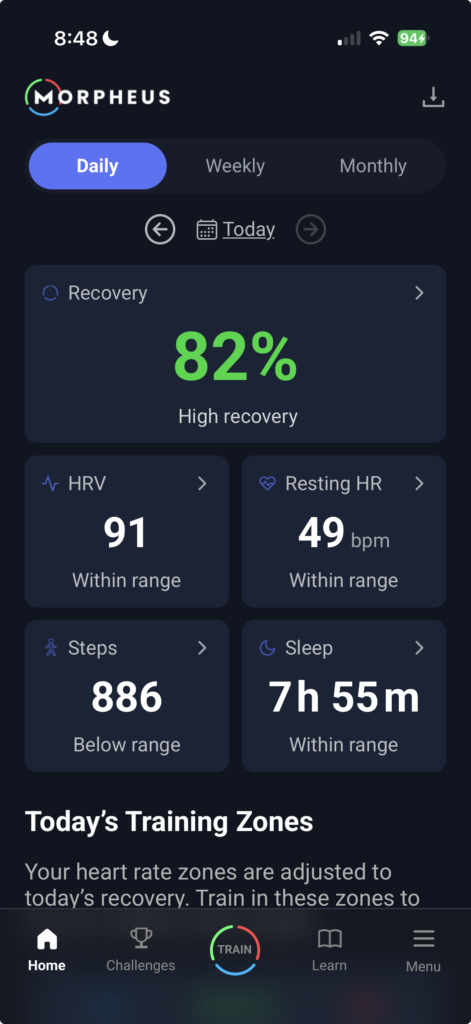
No matter what your fitness goal is, recovery is what allows your body to improve.
Training creates stress.
Recovery is when your body adapts and gets stronger.
Morpheus is designed to help you understand how recovered your body is each day, so you can train smarter—not just harder.
To unlock the full power of recovery, follow the steps and best practices below.
Note: At least one HRV / Recovery Test using the Morpheus M7 is required to fully unlock all app features.
HRV Best Practices
Heart Rate Variability (HRV) is a very sensitive measurement. Following these simple guidelines will help ensure the most accurate results.
For best accuracy:
Take your measurement in the morning, ideally 10–30 minutes after waking
Avoid stimulants beforehand (caffeine, nicotine, etc.)
Stay relaxed during the test
No talking
No eating
No moving
No phone scrolling or distractions
Breathe naturally — do not control your breathing or hold your breath
Choose a quiet, calm environment whenever possible
Use the same body position every time:
Lying down is recommended for most users
If your resting heart rate is in the low 40s or lower and your HRV is consistently above 90 (with Morpheus), a seated measurement may be better
Consistency matters more than perfection.
Checking Your Recovery
Step 1: Sync sleep data (if using a third-party device)
If you use a third-party device (such as Garmin) to track your sleep and you want Morpheus to use that data, make sure your sleep data is synced before checking your recovery.
Open the third-party app (for example, Garmin Connect)
Allow it to fully sync your sleep data
Open the Morpheus app and make sure the sleep duration appears correctly
Morpheus will automatically pull in your sleep duration once the data is available. You will see it in the sleep box on the home screen.
If sleep data has not synced yet, you can still continue, and you can manually enter your sleep on the recovery questionnaire.
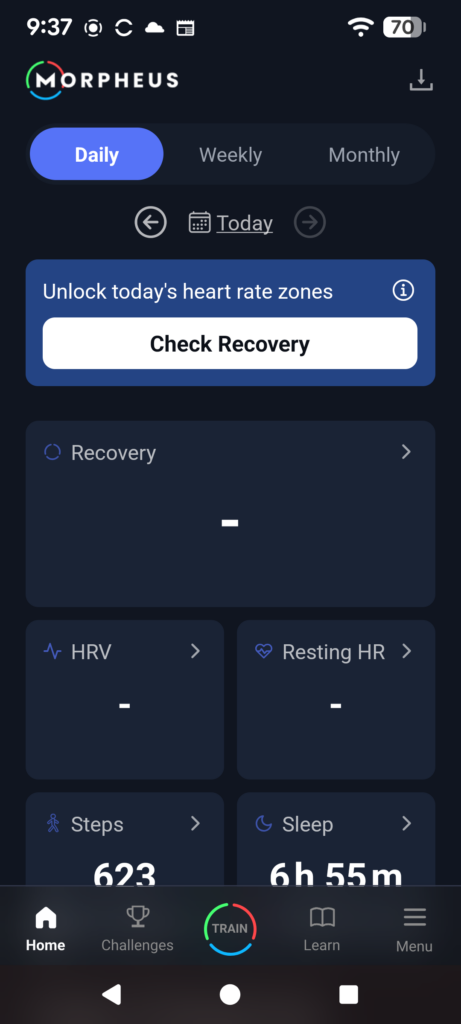
Step 2: Check your recovery
Tap Check Recovery from the center of the Home Screen
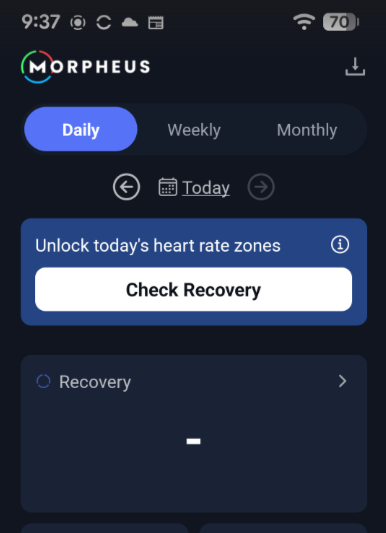
You’ll first be guided through a short recovery questionnaire.
Recovery Questionnaire
Here you’ll enter:
Hours of sleep
Note: if you synced your sleep hours from a 3rd party tracking system, you will see the sleep slider bar already populated. You can choose to change it if you want to. Whatever is set on the slider bar is the final sleep data for the day.Sleep quality
Muscle soreness
Overall well-being
You can also add optional notes if you’d like to track anything specific.
If you are wondering which rating to choose for the Sleep Quality or How do you feel slider bars, tap on the “i” symbol at the top right of the screen for more descriptive text about each rating.
Once complete, tap Continue.
To fully unlock Morpheus, you must complete at least one HRV measurement with the Morpheus M7 heart rate monitor.
While daily HRV tests are not required, measuring HRV consistently produces the most accurate recovery scores and training zones. A minimum of 4 tests per week is required for accurate data.
The Recovery Test
Turn the M7 On (Important)
The M7 only turns on when it’s being worn correctly.
Attach the transmitter to the strap
Put the strap on your chest properly
For tips on fit and usage, please review Heart Rate Monitor Basics .
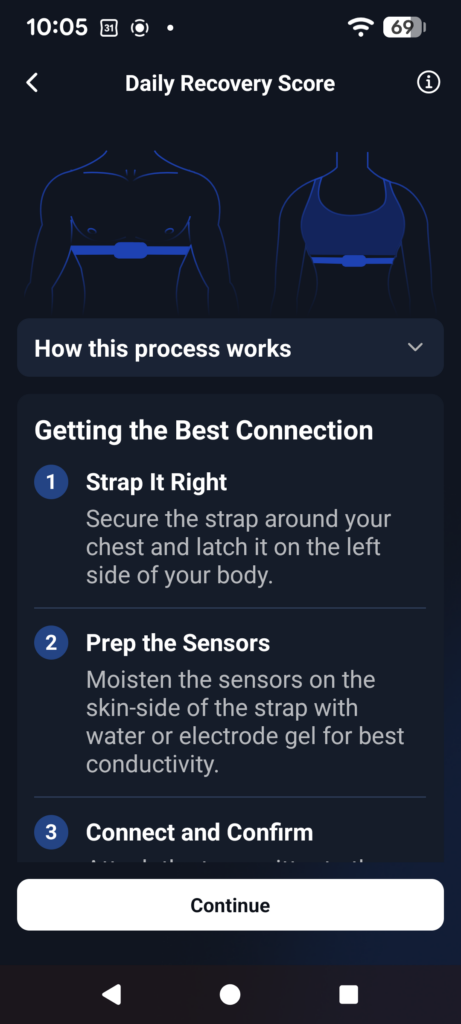
Connecting the M7
After tapping Continue on the Recovery Questionnaire:
Tap Connect HR Monitor
Select your M7 from the Bluetooth device list
If it doesn’t appear right away, wait a few seconds for the app to detect it.
Each M7 has a unique ID, printed on the back of the sensor, to help you identify it if multiple devices are nearby.
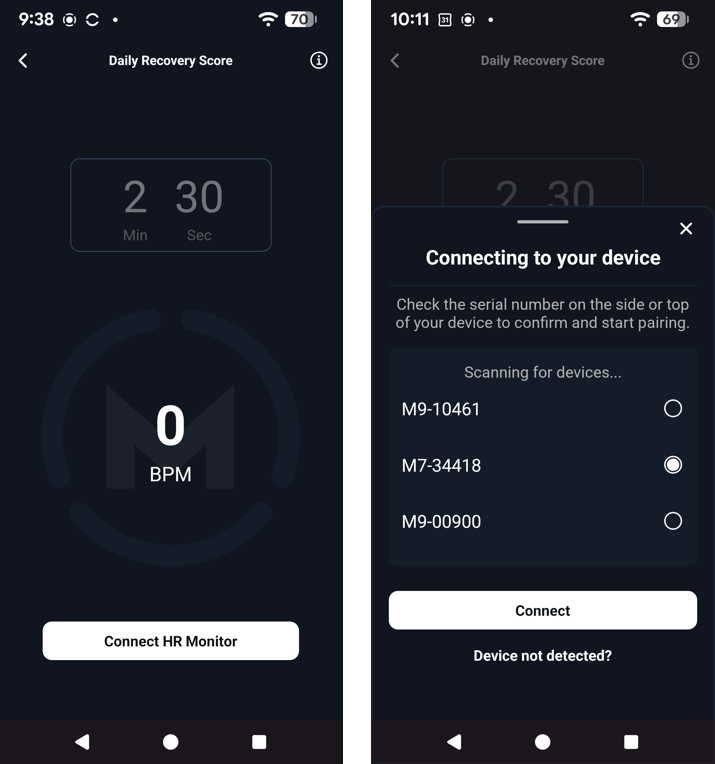
3. You can choose to set this as your default device so that it will automatically connect each time going forward after tapping on Connect HR Monitor.
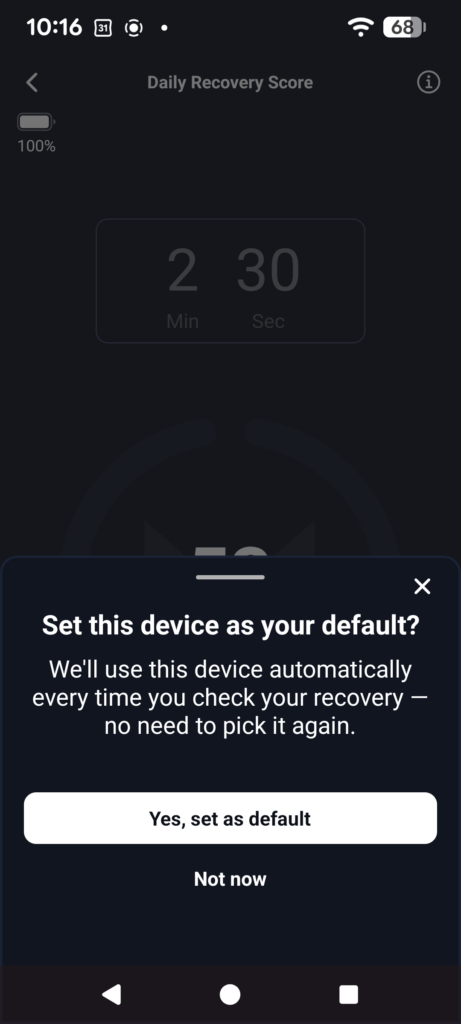
Starting the Test
Once connected, the app will display Start Test at the bottom of the screen.
You will also see the remaining battery life of your heart rate monitor at the top left of the screen.
It’s best to wait until your heart rate is relatively stable before pressing the Start Test button.
Morpheus will automatically enter a period of HR Stabilizing. This stabilization step helps ensure the most accurate reading possible.
This usually takes about 10-20 seconds. If you are active or moving around and your heart rate is not relatively stable, it will take longer.
Once your heart rate is stable enough, the 2:30 HRV test begins automatically
During the test, you’ll see a 2:30 countdown timer at the top of the screen and your heart rate in the middle of the screen.
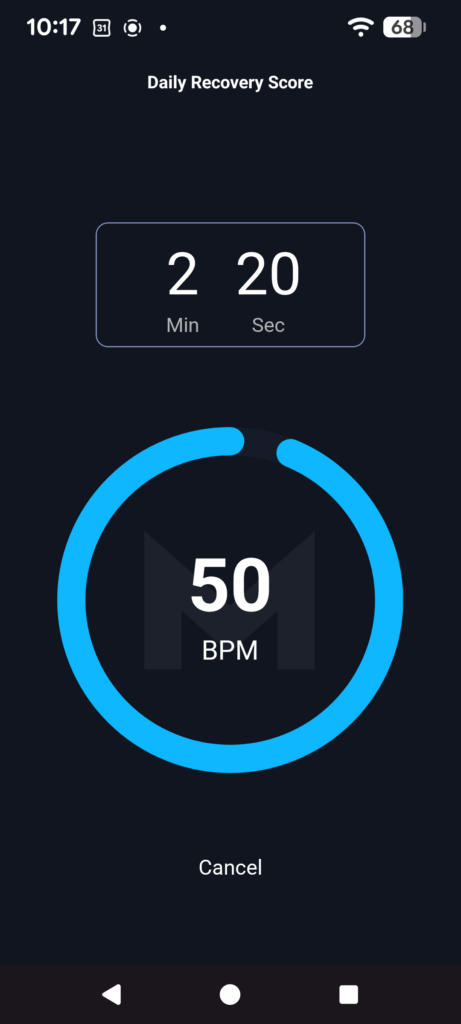
Note: We recommend that you do NOT watch the screen during the test. Just relax and close your eyes and breathe normally. Watching the screen can cause unintentional anxiety or breathing changes as your brain processes the numbers that you are seeing. When the test has ended, there will be a double vibration haptic so you’ll be able hear or feel that it has ended.
To ensure you experience the double vibration at the end of the test, you will need to ensure that your phone settings allow for it.
- iOS: Settings — Accessibility — Touch — Vibration = ON.
Also, under Sounds & Haptics, you need to have System Haptics toggled ON and under Haptics specifically, you need to have that set to “Always Play” or “Play in Silent Mode” - Android: Settings — Sound & Vibration — Vibration & Haptics — Use vibration & haptics = ON — Alarm vibration = ON
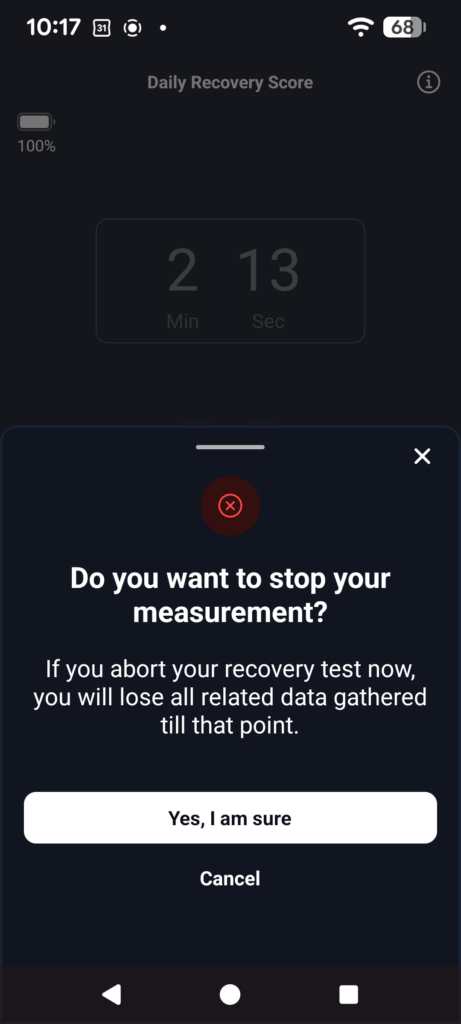
If for any reason you need to terminate the test before it has been completed, you can tap Cancel at the bottom of the screen. If something distracting happens during the test, stopping it and then restarting at when the distraction has been removed, is the best way to ensure accurate data.
Note: It is not possible to retest after your test has been fully completed and calculated. And completed recovery test data cannot be deleted.
Estimate your Recovery
At the bottom of the Recovery Questionnaire, you may notice an Estimate Recovery button.
- You will not see this option right away. This is only available if you have been very consistent with measuring your HRV. You will not see this button if you do not have enough recent data.
This process uses data other than HRV and RHR (such as previous day workout(s), prior HRV/RHR/Recovery data, and the data on your recovery questionnaire) to give you an estimated Recovery Score.
- Because this option is not using HRV and RHR this value will not be as accurate as if you had completed the recovery test, so it should be used sparingly (ie no more than 1-2 times per week)
- An example of when it may make sense to use the Estimate Recovery option is:
- You’ve been very consistent measuring your HRV each morning, but one day life happens and you just can’t complete your HRV test under normal testing conditions, or you simply forget to do the test in the morning. In a scenario like this, it is better to choose Estimate Recovery than it is to complete your HRV test later in the day.
- You will see estimated recovery score denoted with an asterisk* next to it on the home screen and on the weekly or monthly bar chart.
You’ve Completed Your Recovery Test (or estimated Recovery)
Once your recovery test is complete:
Your Recovery Score
Your HRV (not included when estimating recovery)
And your daily training zones
will all appear on the Home Screen.